

Knowing the roof pitch in degrees is useful when planning a new roof, replacing roofing materials, checking an existing structure, or discussing a roofing project with a professional. The pitch describes how steep the roof is, and measuring it correctly can help you understand the roof’s design and choose suitable materials.
The good news is that you do not always need specialist equipment to calculate a roof’s pitch. With a level, tape measure and a basic understanding of the calculation, you can work out the roof angle fairly easily.
In this guide, we explain how to calculate roof pitch in degrees, what measurements you need, and how to avoid some common mistakes.
What Is Roof Pitch?
Roof pitch refers to the steepness or slope of a roof. It is commonly expressed as a ratio, such as 4:12, or as an angle in degrees.
For example, a roof that rises 4 inches for every 12 inches of horizontal distance has a 4:12 pitch. The same slope can also be expressed as an angle of approximately 18.4 degrees.
Understanding both measurements can be helpful because roofing professionals, building plans and manufacturers may use different ways of describing the same roof slope.
Why Measure Roof Pitch in Degrees?
There are several reasons you may want to know the roof pitch angle.
A roof’s slope can affect:
- The type of roofing material that can be installed
- How rainwater runs from the roof
- Drainage and water management
- The appearance of the building
- Access and working conditions for roofers
- Structural and design considerations
- The suitability of certain roofing systems
If you are replacing a roof, an accurate measurement can also make it easier to communicate the roof design to your roofing contractor.
How to Calculate Roof Pitch in Degrees
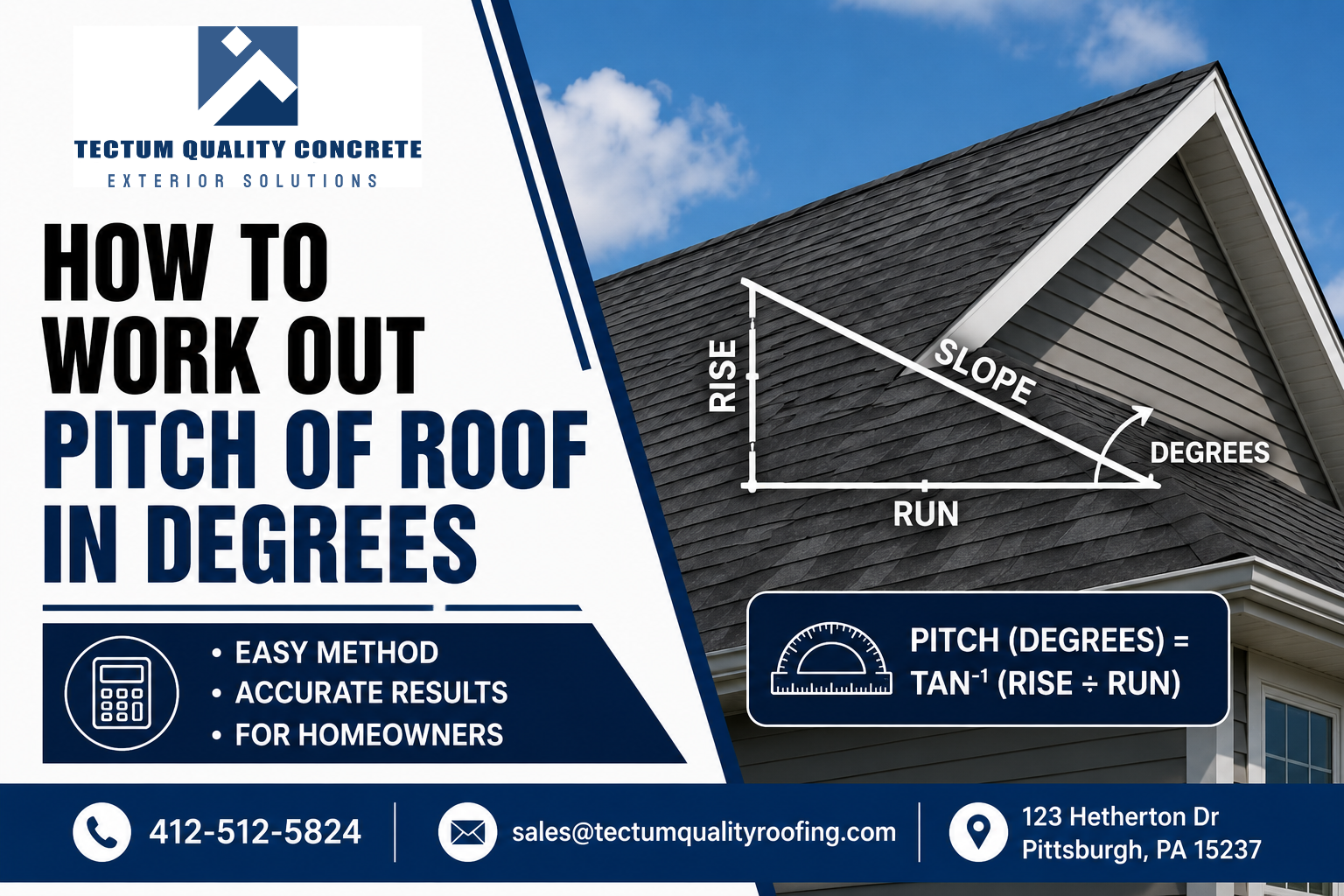
The basic calculation uses the rise and run of the roof.
Rise is the vertical distance the roof increases over a set horizontal distance.
Run is the horizontal distance from the roof’s centre line or starting point to the point being measured.
The formula is:
Roof angle = arctan(rise ÷ run)
The result is then expressed in degrees.
For example, suppose you measure a roof and find that it rises 6 inches over a horizontal run of 12 inches.
The calculation would be:
arctan(6 ÷ 12)
arctan(0.5) = approximately 26.6°
Therefore, the roof has a pitch of approximately 26.6 degrees.
An Easy Way to Measure Roof Pitch
You can often measure the slope from inside the loft or attic rather than climbing onto the roof. This is generally a safer approach.
You will need:
- A spirit level
- A tape measure
- A pencil or marker
- A calculator with an arctangent function, or a suitable online calculator
Step 1: Find a Suitable Rafter
Choose an accessible rafter where you can take measurements safely. Avoid putting yourself in a position where you need to walk directly on the roof covering.
Step 2: Place the Level Horizontally*
Hold your spirit level so that it is completely horizontal. A longer level can make this easier because it provides a more reliable reference.
Step 3: Measure the Rise
From the level, measure vertically down to the rafter. Record the vertical measurement.
For example, if the vertical rise is 6 inches over a 12-inch horizontal distance, your rise is 6 and your run is 12.
Step 4: Calculate the Angle
Divide the rise by the run and use the inverse tangent, or arctan, function on your calculator.
Angle = arctan(rise ÷ run)
The answer is the roof pitch in degrees.
Example of a Roof Pitch Calculation
Let’s use another example.
Imagine you have measured:
- Rise = 8 inches
- Run = 12 inches
First, divide the rise by the run:
8 ÷ 12 = 0.667
Then calculate the inverse tangent:
arctan(0.667) ≈ 33.7°
The roof therefore has an angle of approximately 33.7 degrees.
This method works regardless of the particular measurement units you use, provided the rise and run are measured using the same units.
Roof Pitch Chart in Degrees
A pitch ratio can be converted into an approximate angle in degrees.
| Roof Pitch | Approximate Angle |
| 2:12 | 9.5° |
| 3:12 | 14.0° |
| 4:12 | 18.4° |
| 5:12 | 22.6° |
| 6:12 | 26.6° |
| 7:12 | 30.3° |
| 8:12 | 33.7° |
| 9:12 | 36.9° |
| 10:12 | 39.8° |
| 11:12 | 42.5° |
| 12:12 | 45.0° |
These figures are useful for understanding the relationship between roof pitch and angle, but an actual roof should be measured rather than estimated from appearance.
Can You Calculate Roof Pitch Without Going on the Roof?
Yes. In many cases, measuring from inside the loft or attic is preferable.
If you have safe access to the roof structure, you can measure the rise and run of a rafter without stepping onto the roof covering. This can reduce the risk of slipping, damaging roofing materials or falling from the roof.
If the roof structure is difficult to access or you are unsure how to take the measurement safely, it is better to have a qualified roofing professional inspect it.
Common Mistakes When Measuring Roof Pitch
Getting an accurate measurement is important. A few simple mistakes can produce an incorrect result.
Measuring the Roof Covering Instead of the Structure
Tiles, shingles and other roofing materials can sometimes make the surface difficult to measure accurately. Where practical, measure the underlying roof slope from a safe location.
Using Different Units
Do not mix inches and centimetres in the same calculation. Convert your measurements to the same unit before calculating the slope.
Forgetting That Run Is Horizontal
The run is the horizontal distance, not the length of the rafter itself. Using the rafter length as the run will give you the wrong result.
Estimating by Eye
A roof can look steeper or flatter than it actually is. Even a small difference in angle can matter when planning roofing work, so measuring is more reliable than visual estimation.
Climbing Onto the Roof to Take a Simple Measurement
There is often no need to climb onto the roof just to determine its pitch. If the measurement can be taken safely from inside, that is usually the better option.
Is Roof Pitch the Same as Roof Slope?
The terms roof pitch and roof slope are often used interchangeably, but technically they can be represented in different ways.
Roof slope may be expressed as a ratio or percentage, while pitch is commonly described as a rise-over-run measurement. The angle in degrees provides another way of describing the same geometric relationship.
For practical roofing discussions, it is helpful to clarify whether someone is referring to the ratio, percentage or angle.
When Should You Get Professional Help?
Calculating the angle is relatively straightforward, but understanding what that measurement means for your roofing project can be more complicated.
A professional roofer can assess the roof’s condition, structure, drainage, existing materials and other factors before recommending a solution.
If you are considering repairs, replacement or a new roofing system, Tectum Quality Roofing can help you assess your roofing requirements and determine the most appropriate approach.
Final Thoughts
Working out the roof pitch in degrees does not have to be complicated. Measure the vertical rise and horizontal run, divide the rise by the run, and use the inverse tangent function to find the angle.
The key formula to remember is:
Roof angle = arctan(rise ÷ run)
For example, a roof with a 6-inch rise over a 12-inch run has an angle of approximately 26.6 degrees.
If you are measuring your roof as part of a repair or replacement project, remember that pitch is only one part of the assessment. A professional inspection can identify other factors that may affect the work required.