

Metal roofing is a popular choice for homeowners because of its durability, clean appearance, and ability to withstand demanding weather conditions. However, installing a metal roof is not simply a matter of choosing a panel and putting it on the roof. The roof pitch must also be suitable for the specific metal roofing system.
So, what is the minimum pitch on a metal roof?
There is no single answer for every metal roof. Some metal roofing systems can be installed on very low slopes, while others require a steeper pitch. Depending on the panel design, a metal roof may have a minimum slope of 1/4:12, 1/2:12, 2:12, 3:12, or even 4:12. The manufacturer’s installation requirements should always be checked before selecting a roofing system.
For homeowners considering metal roofing in Pittsburgh, understanding roof pitch can help you choose a system that is appropriate for your home and local weather conditions.
What Does Roof Pitch Mean?
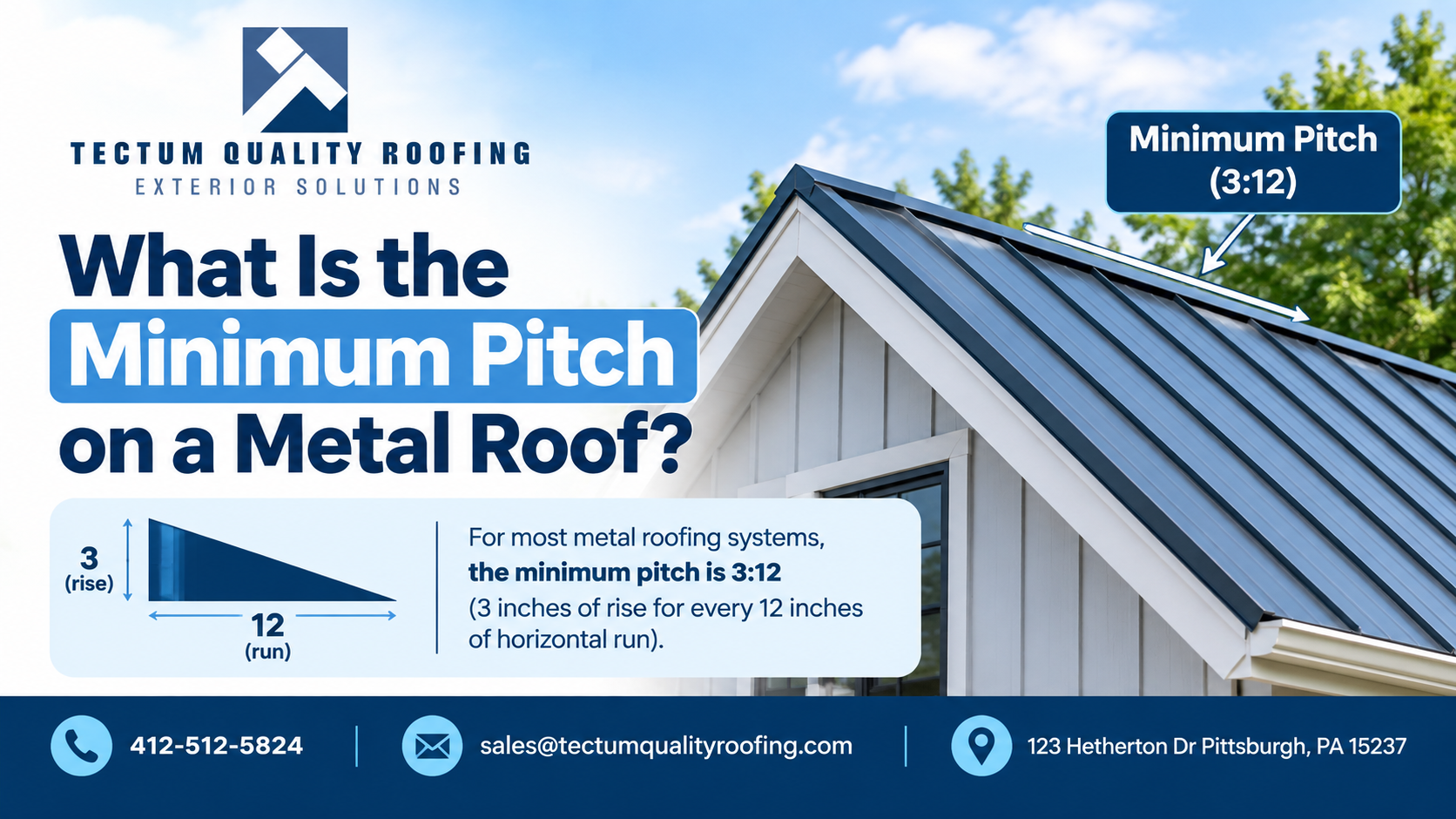
Roof pitch describes how much a roof rises vertically compared with its horizontal run. It is commonly written as a ratio, such as 3:12.
For example, a 3:12 roof pitch means the roof rises 3 inches for every 12 inches of horizontal distance.
A lower number means the roof is shallower, while a higher number means the roof is steeper.
Roof pitch affects more than the appearance of your home. It can influence water runoff, roofing material selection, installation requirements, ventilation, flashing, and the overall performance of the roofing system.
What Is the Minimum Pitch on a Metal Roof?
The minimum pitch on a metal roof depends on the type of metal roofing system being installed.
Some structural metal panel systems can be designed for slopes as low as 1/4:12, which equals about 1.2 degrees. Other systems require a higher slope because they rely more heavily on shedding water from the roof surface.
Metal Construction Association guidance also distinguishes between different metal roof systems. Certain standing-seam systems may be designed for slopes as low as 1/4:12, while some lapped metal roofs have different minimum slope requirements.
This is why it is not a good idea to assume that any metal panel can be installed on a low-slope roof.
The exact panel manufacturer’s specifications should be followed for the project.
Can a Metal Roof Be Installed on a Low-Slope Roof?
Yes, some metal roofing systems are specifically designed for low-slope applications.
For example, certain hydrostatic metal panel systems can be installed at slopes around 1/2:12, depending on the product and project conditions. Other metal systems have minimum requirements of 2:12 or higher.
A low-slope metal roof must be designed and installed carefully because water moves more slowly across the surface. Seams, fasteners, flashing, penetrations, valleys, and other areas need to be properly detailed to help prevent water from entering the building.
The roof’s location and geometry can also affect the appropriate minimum slope.
What Is the Minimum Slope for Standing Seam Metal Roofing?
Standing seam metal roofing comes in several different profiles, so the minimum slope is not identical for every product.
Some standing seam systems can be installed at 1/2:12, while others require 2:12 or more. Certain architectural metal panels have minimum requirements of 3:12 or 4:12.
For this reason, homeowners should avoid choosing a standing seam panel based only on its appearance. The product’s technical specifications should be reviewed before installation.
A roofing contractor can also inspect the existing roof and determine which systems are appropriate for its pitch.
Is a 3:12 Pitch Good for a Metal Roof?
A 3:12 roof pitch can be suitable for many metal roofing systems, but the specific panel still matters.
A 3:12 roof rises 3 inches for every 12 inches of horizontal run. It is steeper than many low-slope applications, which can provide better water movement across the roof.
However, some metal roofing products have minimum slopes of 3:12, while others can be installed on considerably lower slopes. For example, certain metal shingle and architectural panel systems require 3:12 or 4:12 minimum slopes.
If your roof has a 3:12 pitch, a roofing professional should still verify the requirements of the metal roofing product you are considering.
View our location on Google Maps
Why Does Metal Roof Pitch Matter?
Roof pitch plays an important role in how water moves across the roofing system.
On a steep roof, rainwater can generally move toward the eaves more quickly. On a shallow roof, water takes longer to drain, which makes the design and installation of seams, flashing, underlayment, and drainage components especially important.
An incorrect slope can contribute to problems such as:
- Water collecting around seams
- Leaks around roof penetrations
- Failed flashing
- Moisture entering the roof deck
- Premature deterioration of roofing materials
- Drainage problems during heavy rain
The correct pitch helps the roofing system perform as intended.
Does Snow Affect the Minimum Pitch of a Metal Roof?
Snow should be considered when evaluating a metal roof, particularly in areas that receive winter weather.
Metal roofs are often valued for their ability to shed snow, but that does not mean every metal roof will perform the same way. Roof pitch, panel profile, snow load, roof geometry, and snow-retention requirements can all affect the final design.
For Pittsburgh homeowners, a professional roof assessment can help determine whether the existing roof structure and pitch are appropriate for the selected metal roofing system.
How Do You Determine the Pitch of an Existing Roof?
Roof pitch can be measured by determining how many inches the roof rises over a 12-inch horizontal run.
For example:
- 1 inch rise over 12 inches = 1:12 pitch
- 2 inches rise over 12 inches = 2:12 pitch
- 3 inches rise over 12 inches = 3:12 pitch
- 4 inches rise over 12 inches = 4:12 pitch
- 6 inches rise over 12 inches = 6:12 pitch
A roofing professional can measure the pitch safely and accurately during an inspection.
Knowing the roof pitch is particularly helpful when you are comparing metal roofing options because the manufacturer’s minimum slope requirements can immediately eliminate products that are not suitable.
What Happens If Metal Roofing Is Installed Below Its Required Pitch?
Installing a metal roofing system below its specified minimum slope can create serious performance problems.
If the roof does not have enough slope for the selected panel system, water may not drain as intended. Seams and flashing may be exposed to prolonged moisture, increasing the risk of leaks.
It can also create problems with product warranties if the installation does not follow the manufacturer’s requirements.
The solution is not always to increase the roof pitch. In some cases, a different metal roofing system designed for low-slope applications may be more appropriate.
How Can a Pittsburgh Roofing Contractor Help?
Choosing the right metal roofing system involves more than comparing colors and panel styles. Your contractor should consider the existing roof pitch, roof structure, drainage, flashing, local weather, panel specifications, and installation requirements.
At Tectum Quality Roofing, we help homeowners in Pittsburgh and surrounding areas evaluate their roofing needs. Whether you are considering a metal roof, replacing an aging roof, or dealing with leaks and storm damage, a professional inspection can help you understand your options.
If you are not sure whether your roof has enough slope for metal roofing, don’t guess. Let a roofing professional measure the pitch and determine which roofing systems may be appropriate for your property.
Contact Tectum Quality Roofing today to schedule a roof evaluation and request a free estimate.
Frequently Asked Questions
- What is the minimum pitch on a metal roof?
There is no universal minimum pitch for every metal roof. Depending on the system, some metal panels can be installed at slopes as low as 1/4:12 or 1/2:12, while other products require 2:12, 3:12, or 4:12. Always follow the specific manufacturer’s requirements.
- Can you put a metal roof on a 2:12 pitch?
Yes, some metal roofing systems are designed for a 2:12 slope. However, other products require a steeper minimum slope, so the exact panel system must be checked before installation.
- Can metal roofing be installed on a 1:12 pitch?
Some metal roofing systems can accommodate a 1:12 pitch, but not all. Low-slope applications require a roofing system specifically designed for that condition.
- Is 3:12 a good pitch for a metal roof?
A 3:12 pitch can work well with many metal roofing systems, but the product’s minimum slope requirements should always be confirmed before installation.
- What is the minimum pitch for standing seam metal roofing?
The minimum pitch varies by standing seam system. Some products are designed for 1/2:12 slopes, while others require 2:12 or more. Certain standing seam-style products require 3:12 or 4:12.
- Does a metal roof need a steeper pitch than shingles?
Not necessarily. Metal roofing systems are available for a wide range of slopes. The required pitch depends on the particular metal panel and its installation method.
- Does roof pitch affect metal roof cost?
It can. Pitch may affect installation difficulty, safety requirements, labor, material handling, and the type of roofing system that can be used.
- How do I find the pitch of my roof?
You can measure the vertical rise over a 12-inch horizontal run using a level and tape measure. A professional roofing contractor can also measure the pitch during an inspection.
- Can a roofing contractor install metal roofing on a low-slope roof?
Yes, provided the selected metal roofing system is approved for the roof’s slope and is installed according to manufacturer requirements and applicable building codes.
- Should I choose a metal roof based only on its minimum pitch?
No. Minimum pitch is only one consideration. The panel profile, seam design, drainage, roof structure, flashing, local conditions, installation method, and manufacturer’s requirements should all be reviewed before choosing a system.